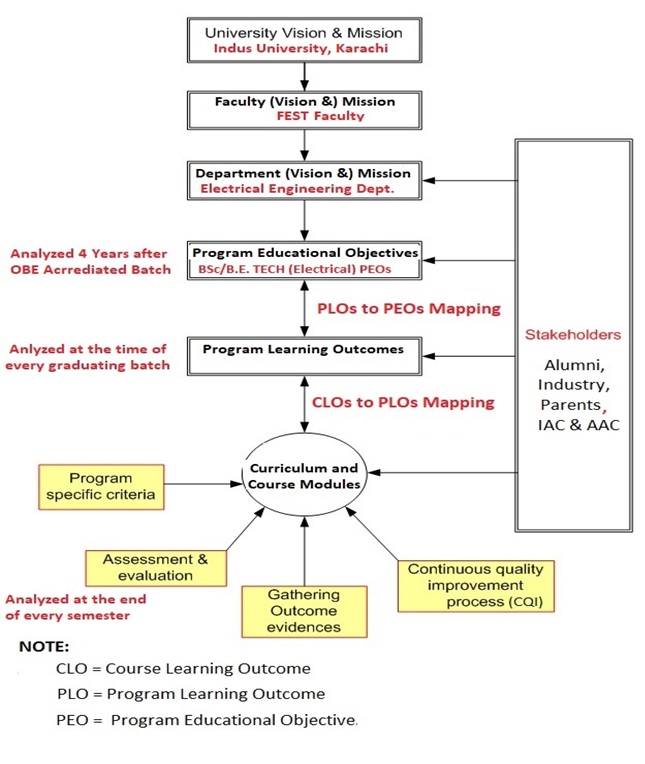
The Department of Electrical Engineering at Indus University prepares students for the evolving electrical and electronics industry by combining theoretical knowledge with practical training. Focus areas include power systems, renewable energy, automation, telecommunications, and control engineering. With state-of-the-art labs, advanced tools, and industry collaborations, students gain hands-on experience in cutting-edge technologies.
Expert faculty fosters analytical thinking, problem-solving, and innovation. Through project-based learning, research, and industry-integrated training, graduates are equipped to lead advancements in energy solutions, smart grids, and emerging technologies, ensuring they contribute to technological innovation and shape the future of engineering.
The Department of Science and Technology's mission is to develop itself as Pakistan's finest institute, known for its cutting-edge expertise and hands-on experience in science and technology. We want to create a spirit of inquiry and curiosity in both academics and students. By providing our graduates with a thorough understanding of technical fundamentals as well as a global perspective, we hope to influence the future of Science and Technology Education in Pakistan and beyond.
Our objective is to achieve excellence in teaching, research, and innovation, resulting in highly qualified graduates who combine contemporary scientific knowledge with ethical ideals. We want to equip our students to contribute to technological innovation and industrial development, consequently playing an important part in the country's progress. Our mission is to prepare each graduate to tackle the difficulties of the modern world, with a strong sense of responsibility and leadership.
The Department of Electrical Engineering at Indus University is dedicated to fostering excellence in education, research, and innovation. Our key objectives include:
The Department of Electrical Engineering at Indus University provides world-class facilities designed to foster innovation, research, and hands-on learning. Our students have access to cutting-edge infrastructure and advanced tools to shape the future of electrical engineering.
| Sr | Pre-Requisite | Course ID | Course Name | Cr. Hr |
|---|---|---|---|---|
| SEMESTER - 1 | ||||
| 1 | ELH-111 | Islamic Studies/Social Ethics | 2 | |
| 2 | ELC-111 | Applications of Information and Communication Technologies | 3 | |
| 3 | ELH-112 | Functional English | 3 | |
| 4 | ELN-111 | Calculus & Analytical Geometry | 4 | |
| 5 | ELF-122 | Computer Programming | 2 | |
| SEMESTER - 2 | ||||
| 1 | ELN-121 | Applied Physics | 3 | |
| 2 | ELH-121 | Ideology and Constitution of Pakistan | 2 | |
| 3 | ELN-122 | Differential Equations | 3 | |
| 4 | ELI-121 | Applied Mechanics | 3 | |
| 5 | ELF-121 | Linear Circuit Analysis | 3 | |
| SEMESTER - 3 | ||||
| 1 | ELH-211 | Civics and Community Engagement | 2 | |
| 2 | ELH-212 | Technical Report Writing | 3 | |
| 3 | ELN-211 | Probability and Statistics | 3 | |
| 4 | ELH-213 | Chinese History and Language | 2 | |
| 5 | ELS-211 | Professional Ethics | 2 | |
| 6 | ELI-211 | Applied Thermodynamics | 3 | |
| 7 | ELF-211 | Engineering Drawing | 3 | |
| SEMESTER - 4 | ||||
| 1 | ELH-221 | Technopreneurship | 2 | |
| 2 | ELI-221 | Internet of Things (IOT) | 3 | |
| 3 | ELF-221 | Electrical Network Analysis | 2 | |
| 4 | ELB-221 | Instrumentation and Measurement | 3 | |
| 5 | ELB-222 | Electrical Machines | 3 | |
| 6 | ELF-222 | Signals and Systems | 2 | |
| 7 | ELF-223 | Electronic Devices and Circuits | 3 | |
| SEMESTER - 5 | ||||
| 1 | ELI-311 | Biomedical Technology | 3 | |
| 2 | ELN-311 | Numerical Analysis | 3 | |
| 3 | ELF-311 | Micro-Controller Systems | 3 | |
| 4 | ELB-311 | Electrical Power Transmission | 3 | |
| 5 | ELB-312 | Control Technology | 3 | |
| 6 | ELD-311 | Project Part-I | 3 | |
| SEMESTER - 6 | ||||
| 1 | ELB-321 | Communication Systems | 3 | |
| 2 | ELD-321 | Renewable Energy Technology | 3 | |
| 3 | ELD-322 | Power Generation Technology | 3 | |
| 4 | ELD-323 | Switchgear and Protective Devices Technology | 3 | |
| 5 | ELD-324 | Industrial Drive and PLC | 3 | |
| 6 | ELD-325 | Project Part-II | 3 | |
| SEMESTER - 7 | ||||
| 1 | ELB-411 | Electrical Power Distribution and Utilization | 2 | |
| 2 | ELD-411 | High Voltage Technology | 2 | |
| 3 | ELD-412 | Electrification Technology | 2 | |
| 4 | ELD-413 | Power Electronics | 2 | |
| 5 | ELD-414 | Robotics Technology | 3 | |
| 6 | ELD-415 | Smart Grid Technology | 3 | |
| 7 | ELC-411 | Artificial Intelligence | 3 | |
| SEMESTER - 8 | ||||
| 1 | ELD-421 | Supervised Industrial Training | 16 | |
| Sr | Pre-Requisite | Course ID | Course Name | Cr. Hr |
|---|---|---|---|---|
| SEMESTER - 1 | ||||
| 1 | EEH-111 | Islamic Studies/Social Ethics | 2 | |
| 2 | EEC-111 | Applications of Information and Communication Technologies | 3 | |
| 3 | EEH-112 | Functional English | 3 | |
| 4 | EEN-111 | Calculus & Analytical Geometry | 3 | |
| 5 | EEF-111 | Workshop Practices (Lab) | 1 | |
| 6 | EEC-121 | Computer Programming | 2 | |
| SEMESTER - 2 | ||||
| 1 | EEN-121 | Applied Physics | 3 | |
| 2 | EEH-121 | Ideology and Constitution of Pakistan | 2 | |
| 3 | EEF-121 | Differential Equations | 3 | |
| 4 | EEI-121 | Applied Mechanics | 3 | |
| 5 | EEF-122 | Linear Circuit Analysis | 3 | |
| 6 | EEF-112 | Solid State Electronics | 2 | |
| SEMESTER - 3 | ||||
| 1 | EEH-211 | Civics and Community Engagement | 2 | |
| 2 | EEH-212 | Technical Report Writing | 3 | |
| 3 | EEQ-211 | Probability and Statistics | 3 | |
| 4 | EEH-213 | Chinese History and Language | 2 | |
| 5 | ESS-211 | Profesional Ethics | 2 | |
| 6 | EEI-211 | Applied Thermodynamics | 3 | |
| 7 | EEC-211 | Technical Drawing (Lab) | 1 | |
| 8 | EEF-211 | Digital Electronics | 2 | |
| SEMESTER - 4 | ||||
| 1 | EEH-221 | Technopreneurship | 2 | |
| 2 | EEC-221 | Internet of Things (IOT) | 3 | |
| 3 | EEF-221 | Electrical Network Analysis | 3 | |
| 4 | EEF-222 | Electronic Devices | 3 | |
| 5 | EEB-221 | Electrical Machines | 3 | |
| 6 | EEB-222 | Instrumentations and Measurements | 3 | |
| 7 | EEF-223 | Signals and Systems | 2 | |
| SEMESTER - 5 | ||||
| 1 | EEI-311 | Biomedical Technology | 3 | |
| 2 | EEN-311 | Numerical Analysis | 3 | |
| 3 | EEB-311 | Microprocessors and Microcontrollers | 3 | |
| 4 | EEB-312 | Amplifiers and Oscillators | 3 | |
| 5 | EEB-313 | Control Systems | 3 | |
| 6 | EED-311 | Project Part-I | 3 | |
| SEMESTER - 6 | ||||
| 1 | EEB-321 | Communication Systems | 3 | |
| 2 | EED-321 | Renewable Energy Technology | 3 | |
| 3 | EEB-322 | Power Generation Technology | 3 | |
| 4 | EED-322 | Switchgear and Protective Devices Technology | 3 | |
| 5 | EED-323 | Industrial Drive and PLC | 3 | |
| 6 | EED-324 | Project Part-II | 3 | |
| SEMESTER - 7 | ||||
| 1 | EED-411 | Integrated Circuits Fabrication | 2 | |
| 2 | EED-412 | Electromagnetic Field Theory | 2 | |
| 3 | EED-413 | Artificial Intelligence | 3 | |
| 4 | EED-414 | Embedded Systems | 3 | |
| 5 | EED-415 | Robotics Technology | 3 | |
| 6 | EED-416 | Renewable Energy | 3 | |
| 7 | EED-417 | Electronics Troubleshooting and Testing (Lab) | 2 | |
| SEMESTER - 8 | ||||
| 1 | EED-421 | Supervised Industrial Training | 16 | |
| Sr | Pre-Requisite | Course ID | Course Name | Cr. Hr |
|---|---|---|---|---|
| SEMESTER - 1 | ||||
| 1 | HS(EE)-111 | Functional English | 2+0 | |
| 2 | HS(EE)-112 | Islamic studies / Ethical Behavior | 2+0 | |
| 3 | GS(EE)-111 | Calculus and Analytical Geometry | 3+0 | |
| 4 | GS(EE)-112 | Applied Physics | 3+1 | |
| 5 | EE-111 | Introduction to Computing | 1+1 | |
| 6 | EE-112 | Linear Circuit Analysis | 3+1 | |
| SEMESTER - 2 | ||||
| 1 | HS(EE)-121 | Communication Skills | 2+0 | |
| 2 | GS(EE)-121 | Differential Equations | 3+0 | |
| 3 | GS(EE)-122 | Multivariable Calculus | 3+0 | |
| 4 | EE-121 | Programming Fundamentals | 3+1 | |
| 5 | EE-122 | Workshop Practice | 0+1 | |
| 6 | EE-123 | Electronic Devices and Circuits | 3+1 | |
| SEMESTER - 3 | ||||
| 1 | HS(EE)-211 | Pakistan Studies | 2+0 | |
| 2 | GS(EE)-211 | Complex Variables and Transforms | 3+0 | |
| 3 | EE-211 | Digital Logic electrical-engineering | 3+1 | |
| 4 | EE-212 | Data Structures and Algorithms | 3+1 | |
| 5 | EE-213 | Electrical Network Analysis | 3+1 | |
| 6 | EE-214 | Engineering Drawing | 0+1 | |
| SEMESTER - 4 | ||||
| 1 | HS(EE)-221 | Professional Ethics | 3+0 | |
| 2 | GS(EE)-221 | Linear Algebra | 3+0 | |
| 3 | EE-221 | Probability Methods in Engineering | 3+0 | |
| 4 | EE-222 | Introduction to Embedded Systems | 3+1 | |
| 5 | EE-223 | Signals and Systems | 3+1 | |
| SEMESTER - 5 | ||||
| 1 | ID(EE)-311 | IDEE-I Thermodynamics | 3+0 | |
| 2 | EE-311 | Electrical Machines | 3+1 | |
| 3 | EE-312 | Electromagnetic Field Theory | 3+0 | |
| 4 | EE-313 | Communication Systems | 3+1 | |
| 5 | EE-314 | Linear Control Systems | 3+1 | |
| SEMESTER - 6 | ||||
| 1 | HS(EE)-321 | Technical Writing | 3+0 | |
| 2 | HS(EE)-322 | Organizational Behavior | 3+0 | |
| 3 | MS(EE)-321 | Engineering Economics | 3+0 | |
| 4 | EE-321 | Breadth Core-I | 3+1 | |
| 5 | EE-322 | Breadth Core-II | 3+1 | |
| SEMESTER - 7 | ||||
| 1 | MS(EE)-411 | Entrepreneurship | 3+0 | |
| 2 | EE-411 | Depth Elective - I | 3+1 | |
| 3 | EE-412 | Depth Elective – II | 3+1 | |
| 4 | ID(EE)-411 | IDEE - II(Introduction to Robotics and Electromechanical Systems) | 3+0 | |
| 5 | EE-413 | Project Part - I | 0+3 | |
| 6 | HS(EE)-412 | Chinese Language Course | Non Credit | |
| SEMESTER - 8 | ||||
| 1 | EE-421 | Depth Elective - III | 3+1 | |
| 2 | EE-422 | Depth Elective - IV | 3+1 | |
| 3 | EE-423 | Depth Elective - V | 3+0 | |
| 4 | EE-413 | Project Part-II | 0+3 | |
| Sr | Pre-Requisite | Course ID | Course Name | Cr. Hr |
|---|---|---|---|---|
| SEMESTER - 1 | ||||
| 1 | ELH-111 | Islamic Studies/Social Ethics | 2 | |
| 2 | ELC-111 | Applications of Information and Communication Technologies | 3 | |
| 3 | ELH-112 | Functional English | 3 | |
| 4 | ELN-111 | Calculus & Analytical Geometry | 4 | |
| 5 | ELF-122 | Computer Programming | 2 | |
| SEMESTER - 2 | ||||
| 1 | ELN-121 | Applied Physics | 3 | |
| 2 | ELH-121 | Ideology and Constitution of Pakistan | 2 | |
| 3 | ELN-122 | Differential Equations | 3 | |
| 4 | ELI-121 | Applied Mechanics | 3 | |
| 5 | ELF-121 | Linear Circuit Analysis | 3 | |
| SEMESTER - 3 | ||||
| 1 | ELH-211 | Civics and Community Engagement | 2 | |
| 2 | ELH-212 | Technical Report Writing | 3 | |
| 3 | ELN-211 | Probability and Statistics | 3 | |
| 4 | ELH-213 | Chinese History and Language | 2 | |
| 5 | ELS-211 | Profesional Ethics | 2 | |
| 6 | ELI-211 | Applied Thermodynamics | 3 | |
| 7 | ELF-211 | Engineering Drawing | 3 | |
| SEMESTER - 4 | ||||
| 1 | ELH-221 | Technopreneurship | 2 | |
| 2 | ELI-221 | Internet of Things (IOT) | 3 | |
| 3 | ELF-221 | Electrical Network Analysis | 2 | |
| 4 | ELB-221 | Instrumentation and Measurement | 3 | |
| 5 | ELB-222 | Electrical Machines | 3 | |
| 6 | ELF-222 | Signals and Systems | 2 | |
| 7 | ELF-223 | Electronic Devices and Circuits | 3 | |
| Sr | Pre-Requisite | Course ID | Course Name | Cr. Hr |
|---|---|---|---|---|
| SEMESTER - 1 | ||||
| 1 | CCC-111 | Programming Fundamentals | 4 | |
| 2 | GED-111 | Application of Information and Communication Technologies | 3 | |
| 3 | GED-121 | Islamic Studies / Ethics | 2 | |
| 4 | GED-131 | Ideology and Constitution of Pakistan | 2 | |
| 5 | GED-141 | Functional English | 3 | |
| 6 | MTS-101 | Mathematics-I (Deficiency for Inter Pre-Medical) | 3 | |
| SEMESTER - 2 | ||||
| 1 | CCC-112 | Object Oriented Programming | 4 | |
| 2 | GED-151 | Civics and Community Engagement | 2 | |
| 3 | GED-161 | Social Sciences (Introduction to Management) | 2 | |
| 4 | GED-171 | QR 1 Discrete Structures | 3 | |
| 5 | GED-181 | Natural Sciences (Applied Physics) | 3 | |
| 6 | MTS-102 | Mathematics-II (Deficiency for Inter Pre-Medical) | 3 | |
| SEMESTER - 3 | ||||
| 1 | CCC-221 | Data Structures | 4 | |
| 2 | CCC-231 | Software Engineering | 3 | |
| 3 | MTS-211 | Calculus and Analytic Geometry | 3 | |
| 4 | CCC-241 | Digital Logic electrical-engineering | 3 | |
| 5 | GED-262 | Entrepreneurship | 2 | |
| 6 | GED-242 | Entrepreneurship | 3 | |
| SEMESTER - 4 | ||||
| 1 | MTS-212 | Multivariable Calculus | 3 | |
| 2 | CCC-222 | Database Systems | 4 | |
| 3 | CCC-251 | Artificial Intelligence | 3 | |
| 4 | CCC-261 | Computer Networks | 3 | |
| 5 | GED-252 | Arts & Humanities (Professional Practices) | 2 | |
| 6 | GED-272 | Probability and Statistics | 3 | |
| SEMESTER - 5 | ||||
| 1 | CCC-342 | Computer Organization and Assembly Language | 3 | |
| 2 | CCC-362 | Information Security | 3 | |
| 3 | CCC-371 | Operating Systems | 3 | |
| 4 | SEC-332 | Domain Core 1(Software Requirement Engineering) | 3 | |
| 5 | SEC-333 | Domain Core 2(Software electrical-engineering and Architecture) | 3 | |
| 6 | MTS-321 | Linear Algebra | 3 | |
| SEMESTER - 6 | ||||
| 1 | SEC-334 | Domain Core 3 (Software Construction and Development) | 3 | |
| 2 | CCC-323 | Analysis of Algorithms | 3 | |
| 3 | ESC-311 | Financial Accounting | 3 | |
| 4 | SEC-335 | Domain Core 4 (Software Quality Engineering) | 3 | |
| 5 | MTS-331 | Technical and Business Writing | 3 | |
| 6 | Domain Elective 1 | 3 | ||
| SEMESTER - 7 | ||||
| 1 | CCC-481 | Final Year Project-I | 2 | |
| 2 | SEC-415 | Domain Core 5 (Software Project Management) | 3 | |
| 3 | Domain Elective 2 | 3 | ||
| 4 | Domain Elective 3 | 3 | ||
| 5 | Domain Elective 4 | 3 | ||
| 6 | Domain Elective 5 | 3 | ||
| SEMESTER - 8 | ||||
| 1 | CCC-482 | Final Year Project - II | 4 | |
| 2 | SEC-416 | Domain Core 6 (Parallel and Distributed Computing) | 3 | |
| 3 | Domain Elective 6 | 3 | ||
| 4 | Domain Elective 7 | 3 | ||
| DOMAIN ELECTIVES | ||||
| 1 | SEE-313 | Web Application Development | 3 | |
| 2 | SEE-414 | Mobile Application Development | 3 | |
| 3 | SEE-423 | Introduction to Data Sciences | 3 | |
| 4 | SEE-424 | Big Data Analytics | 3 | |
| 5 | SEE-437 | Software Verification and Validation | 3 | |
| 6 | SEE-438 | Object Oriented Analysis and electrical-engineering | 3 | |
| 7 | SEE-443 | Internet of Things | 3 | |
| 8 | SEE-444 | Embedded Systems | 3 | |
| 9 | SEE-452 | Machine Learning | 3 | |
| 10 | SEE-453 | Deep Learning | 3 | |
| 11 | SEE-454 | Natural Language Processing | 3 | |
| 12 | SEE-463 | Cyber Forensics | 3 | |
| 13 | SEE-464 | Next Generation Networks | 3 | |
| 14 | SEE-473 | Cloud Computing Concepts | 3 | |
| 15 | CSE-474 | Cloud Networking | 3 | |
| 16 | CSE-481 | HCI and Computer Graphics | 3 | |
| 17 | CSE-482 | Computer Animation | 3 | |
| 18 | CSE-483 | Virtual Reality | 3 | |
| Sr | Pre-Requisite | Course ID | Course Name | Cr. Hr |
|---|---|---|---|---|
| SEMESTER - 1 | ||||
| 1 | CS 5xx | Core Course – I | 3 | |
| 2 | CS 5xx | Core Course – II | 3 | |
| 3 | CS 5xx | Core Course – III | 3 | |
| SEMESTER - 2 | ||||
| 1 | CS 5xx | Core Course – IV | 3 | |
| 2 | CS 5xx | Elective – I | 3 | |
| 3 | CS 5xx | Elective – II | 3 | |
| 4 | SS 3xx | Research Methodology | 3 | |
| SEMESTER - 3 | ||||
| 1 | CS 5xx | Elective – III | 3 | |
| 2 | CS 5xx | MS Thesis-I OR Elective | 3 | |
| SEMESTER - 4 | ||||
| 1 | CS 5xx | Elective-IV | 3 | |
| 2 | CS 5xx | MS Thesis-II OR Elective OR MS Project | 3 | |
| LIST ELECTIVE COURSES | ||||
| 1 | Advanced Algorithm Analysis | |||
| 2 | Advanced Formal Methods | |||
| 3 | Advanced Human-Computer Interaction | |||
| 4 | Advanced Requirements Engineering | |||
| 5 | Advanced Software Project Management | |||
| 6 | Advanced Software System Architecture | |||
| 7 | Advanced Topics in Applied Cryptography | |||
| 8 | Agent Based Modeling | |||
| 9 | Agile Software Development | |||
| 10 | Applied Cryptography | |||
| 11 | Big Data Analytics | |||
| 12 | Complex Networks | |||
| 13 | Component Based Software Engineering | |||
| 14 | Cryptography | |||
| 15 | Database Security | |||
| 16 | Deep Learning | |||
| 17 | Distributed Data Processing | |||
| 18 | Empirical Software Engineering | |||
| 19 | Information Privacy and Security | |||
| 20 | Machine Learning | |||
| 21 | Management & Organizational Behavior | |||
| 22 | Natural Language Processing | |||
| 23 | Quantum Computing and Information security | |||
| 24 | Quantum Cryptography | |||
| 25 | Reliability Engineering | |||
| 26 | Requirements Engineering | |||
| 27 | Research Methodology | |||
| 28 | Research Methods | |||
| 29 | Securing the Internet of Things | |||
| 30 | Security Management | |||
| 31 | Security Testing | |||
| 32 | Software Configuration Management | |||
| 33 | Software Measurement and Metrics | |||
| 34 | Software Process Management & Metrics | |||
| 35 | Software Project Management | |||
| 36 | Software Quality Assurance | |||
| 37 | Software Risk Management | |||
| 38 | Software Testing and Quality Assurance | |||
| 39 | Statistical and Mathematical Methods For Data Science | |||
| 40 | Tools and Techniques in Data Science | |||
| 41 | Trusted Computing | |||
| 42 | Wireless Security | |||
| 43 | Advanced DBMS | |||
| 44 | Advanced Wireless and Mobile Communication Systems | |||
| 45 | Agent Oriented Software Engineering | |||
| 46 | Automated Reasoning | |||
| 47 | Cloud Computing | |||
| 48 | Computational Grid | |||
| 49 | Computer Vision | |||
| 50 | Data Grids | |||
| 51 | Data Mining | |||
| 52 | Data Warehousing | |||
| 53 | electrical-engineering of Intelligent Systems | |||
| 54 | Formal Methods | |||
| 55 | Functional Programming | |||
| 56 | Genetic Algorithms | |||
| 57 | Graphical User Interfaces | |||
| 58 | Information Retrieval Techniques | |||
| 59 | Intelligent User Interfaces | |||
| 60 | Interactive-Systems Development | |||
| 61 | Knowledge based systems | |||
| 62 | Logic Programming | |||
| 63 | Model based Verification | |||
| 64 | Multimedia Systems Development | |||
| 65 | Neural Networks | |||
| 66 | Programming Language electrical-engineering | |||
| 67 | Programming Language Semantics | |||
| 68 | Programming Paradigms | |||
| 69 | Rich Internet Applications | |||
| 70 | Robotics | |||
| 71 | Semantic Web | |||
| 72 | Software electrical-engineering | |||
| 73 | Software Engineering and Formal Specifications | |||
| 74 | Software Maintenance | |||
| 75 | Software Process Improvement | |||
| 76 | Software Quality Engineering | |||
| 77 | Spatial and Temporal Databases | |||
| 78 | Symbolic Computation | |||
| 79 | Text Mining | |||
| PEOs | PEO's Statements |
|---|---|
| PEO-1 | Graduates should have effectiveness to demonstrate solid engineering knowledge through analysis, synthesis, design and entrepreneurial skills for the advancement in career or postgraduate studies. | PEO-2 | Graduates should exhibit professionalism in their work at individual level as well as team member through effective communication and technical skills to achieve sustainable development goals in multi¬disciplinary engineering environment. | PEO-3 | Graduates should make contributions to knowledge and establish best engineering practice through research and development, as to assume positions of technical and/or managerial leadership as their careers develop | PEO-4 | Graduates should express an ethical commitment to the community and the profession through involvement with professional organizations and society | PEO-5 | Graduates should engage in lifelong learning that will enable them to continue their professional development either through advanced course work or continuing self-directed learning and development activities |
Program Learning Outcome (PLO) & Washington Accord Graduate Attribute (WA) (PO = PLO = WA)
| PLO# | PO Attributes | Plo/PO's Statements |
|---|---|---|
| PLO-1 | Engineering Knowledge | An ability to apply knowledge of mathematics, science, engineering fundamentals and an engineering specialization to the solution of complex engineering problems | PLO-2 | Problem Analysis | An ability to identify, formulate, research literature, and analyze complex engineering problems reaching substantiated conclusions using first principles of mathematics, natural sciences and engineering sciences | PLO-3 | Design/ Development of Solutions | An ability to design solutions for complex engineering problems and design systems, components or processes that meet specified needs with appropriate consideration for public health and safety, cultural, societal, and environmental considerations | PLO-4 | Investigation | An ability to investigate complex engineering problems in a methodical way including literature survey, design and conduct of experiments, analysis and interpretation of experimental data, and synthesis of information to derive valid conclusions | PLO-5 | Modern Tool Usage | An ability to create, select and apply appropriate techniques, resources, and modern engineering and IT tools, including prediction and modeling, to complex engineering activities, with an understanding of the limitations | PLO-6 | The Engineer and Society | An ability to apply reasoning informed by contextual knowledge to assess societal, health, safety, legal and cultural issues and the consequent responsibilities relevant to professional engineering practice and solution to complex engineering problems | PLO-7 | Environment and Sustainability | An ability to understand the impact of professional engineering solutions in societal and environmental contexts and demonstrate knowledge of and need for sustainable development. | PLO-8 | Ethics | Apply ethical principles and commit to professional ethics and responsibilities and norms of engineering practice | PLO-9 | Individual and Team Work | An ability to work effectively, as an individual or in a team, on multifaceted and /or multidisciplinary settings | PLO-10 | Communication | An ability to communicate effectively, orally as well as in writing, on complex engineering activities with the engineering community and with society at large, such as being able to comprehend and write effective reports and design documentation, make effective presentations, and give and receive clear instructions | PLO-11 | Project Management and Finance | An ability to demonstrate knowledge and understanding of engineering and management principles and apply these to one’s own work, as a member and leader in a team, to manage projects and in multidisciplinary environments, business practices, such as risk and change management, and understand their limitations | PLO-12 | Lifelong Learning | An ability to recognize importance of, and pursue lifelong learning in the broader context of innovation and technological developments |
Course Learning Outcome (CLO) should have following conditions (i) Action Verb (ii) Condition (iii) Standard (Verbally describe the three steps to apply Nodal Analysis) (C, V, S) Outcome should be SMART: Specific + Measureable + Achievable + Realistic + Time Frame Observable.
| WK | Curriculum (Knowledge Area / Sub Area) |
|---|---|
| WK1 | Humanities and Management Sciences |
| WK2 | Mathematics |
| WK3 | Engineering Fundamentals |
| WK4 | Engineering Specialist Knowledge |
| WK5 | Engineering Design |
| WK6 | Engineering Practice |
| WK7 | Engineering In Society |
| WK8 | Research Literature |
Complex Engineering Problems have characteristic WP1 and some or all of WP2 to WP7, EP1(WP8) and EP2(WP9), that can be resolved with in-depth forefront knowledge
| Llevel | Problem Complexity |
|---|---|
| WP-1 | Depth of Knowledge required |
| WP-2 | Range of conflicting requirements |
| WP-3 | Depth of analysis required |
| WP-4 | Familiarity of issues |
| WP-5 | Extent of applicable codes |
| WP-6 | Extent of stakeholder involvement and level of conflicting requirements |
| WP-7 | Interdependence |
| WP-8 | Consequences |
| WP-9 | Judgement |
There are three Taxonomy Domains and each has different level of attainments, details are available on Annex-C.
| ID | Domain | Attribute | Keywords | Example |
|---|---|---|---|---|
| C1 | Memorize | Rote memorization, recognition, or recall facts | Find, define, label, describe, memorize, locate, recognize, identify, record, name, tell, list, recite, select, relate | Define the basic of electrical quantities and laws in dc and ac system |
| C2 | Understand | Understanding what the facts mean | Convert, transform, examples, match, restate, paraphrase, change, rewrite, give, express, illustrate, extend, generalize, summarize, interpret, compare, explain, predict | Explain and summarize the working culture of a professional engineers in society and organization C3 |
| C3 | Apply | Correct use of the facts, rules, or ideas | Use, apply, change, solve, choose, sketch, modify, make, dramatize, discover, classify, prepare, show, produce, construct, paint, demonstrate, illustrate | Apply the appropriate assembly language for microprocessor (8086) and microcontroller (PIC) |
| C4 | Analyzing | Breaking down information into component part | Analyze, classify, survey, separate, distinguish, infer, categorize, subdivide, inquire, differentiate, probe, attributes, investigate, select, experiment, point out, compare, contrast | Investigate power factor problems that arise during the utilization of electrical energy |
| C5 | Judging | Judging the value or worth of information or ideas | Appraise, deduce, critique, defend, recommend, conclude, decide, criticize, evaluate, consider, weight, judge, support, rate | Evaluate the power factor problems that arise during the utilization of electrical energy |
| C6 | Creating | Combining parts to make a new whole | Plan, role-play, compose, invert, hypothesis, design, revise, construct, develop, collect, predict, formulate, create, organize, originate, combine, arrange | Compose systematically engineering problems and their solutions using appropriate hardware or software |
| ID | Domain | Attribute | Keywords | Example |
|---|---|---|---|---|
| P1 | Perception | The ability to use observed cues to guide physical activity | Detect, describe, differentiate, isolate, distinguish, choose, select, relate, identify | Identify the passive and active components in electronic circuit |
| P2 | Set | The readiness to take a particular course of action | Begin, explain, show, volunteering, proceed, move, state, display | Show the functioning of passive and active components in electronic circuit |
| P3 | Guided Response | The trial-and-error attempts at acquiring a physical skill. With practice, this leads to better performance | Copy, trace, react, response, reproduce, follow | Trace the path of electrical signal in digital system |
| P4 | Mechanism | Learned responses become more habitual and movements can be performed with some confidence and level of proficiency | Mix, assemble, measure, dismantle, construct, calibrate, grind, fix, fasten, mend, sketch, manipulate, heat, display | Construct a block of computer architecture systems using simulation tools |
| P5 | Significant Response Complex | Responses are automatic and proficiency is indicated by accurate and highly coordinated performance with a minimum of wasted effort | Build, organize, mend, sketch, manipulate, heat, display | Organize effectively good quality final year project in a form of system, hardware, software that have commercial potential |
| P6 | Adaptation | Skills are well developed and the individual can modify movements to deal with problem situations or to fit special requirements | Adapt, change, reorganize, alter, vary, rearrange, reorganize, revise | Rearrange a circuit model to represent the behavior of a system |
| P7 | Acting Pure | The skills are so highly developed that creativity for special situations is possible | Arrange, originate, create, design, initiate, compose, combine | Design a system based on mathematical model |
| ID | Domain | Attribute | Keywords | Example |
|---|---|---|---|---|
| A1 | Receive | Willingness to receive information | Ask, choose, identify, point out, reply, select, name, give, follow, hold, use, describe | Give respect to the colleagues idea in meeting |
| A2 | Provide Feedback | Individual actively participating in his or her own learning | Read, answer, select, recite, discuss, write, greet, present, form, help, practice, perform, conform, comply, aid, assist, read | Discuss importance of ac and dc circuits in current technology trend |
| A3 | Judging | The ranges from simple acceptance of a value to one of commitment | Work, justify, differentiate, invite, initiate, study, join, share, propose, report, select, explain, demonstrate | Study the current technology applied in control system engineering |
| A4 | Organize | Individuals go through as they bring together different values, resolve conflicts among them and start to internalize the values | Integrate, relate, complete, organize, defend, identify, synthesize, modify, generalize, formulate, prepare, compare, combine, adhere, arrange | Generalize the role of engineer to solve engineering problems as professional commitment to the nation |
| A5 | Appreciating | Individual has a value system in terms of their beliefs, ideas and attitudes that control their behavior in a consistent and predictable manner | Display, discriminate, verify, modify, revises, serve, listen, practice, influence | Displays a professional commitment to ethical practice |